Through the computer, Meyer has brought together elements that did not physically exist together, such as the sign and the train in "Emotional Crisis" and the old woman and young girl in "The Temptation of the Angel". Has this freedom altered the way Meyer photographs, though? Does this new technology change the process into a completely different experience for the photographer? "Yes, I think it alters how one photographs, in that one has more tools to deal with the problems that face the photographer," replies Meyer. "I might not worry about something being in the frame that bothers me, as I can get rid of it later. In that past, I might have had to make all sorts of adjustments to deal with that problem. But this example is only a minor issue. What is most important is, for instance, the ability that we have today of including soundtracks along with still images, and that in the past was not done at all. We as photographers were brought up and trained to see, but never to hear. That will inevitably change." The image no longer has to end with a 2-dimensional representation of some scene (as in traditional photography), but can now be much more involved and interactive.
The interactivity that Meyer suggests is already becoming a reality. Meyer himself has explored the multimedia environment in his two CD-ROMs, I Photograph to Remember and Truths & Fictions. In I Photograph to Remember, he presents the viewer with photographs of his parents, documenting the struggle they went through during the last few years of their lives. Meyer presents the images to us in a set order, with narration by himself and a small musical score that emphasizes certain transitions. It is a gut-wrenching, emotionally powerful work that surpasses being "just pictures" and becomes a much more powerful narrative that involves the viewer in the experience. The CD illustrates a powerful opportunity for the artist to take creative control, at once being the narrator, the artist, the composer, and the curator. Truths & Fictions works differently from I Photograph to Remember in that it is more of an elaborate companion to the work rather than the work itself. It provides us with insights into the digital medium through letters with Meyer's aquanctances, commentary on the work presented, and information on how the images were formed.
As these very different works illustrate, the CD-ROM still contains much untapped potential. However, the potential is somewhat limited in scope and a new multimedia environment is emerging, namely the internet. "When I first encountered what the internet could offer I realized immediately that this was the next stage from what the CD-ROM could offer as a publishing tool. I always wanted to create a magazine but was horrified at the complexity of distribution, having made a series of books here in Mexico. So that was one of the main attractions to get a fast distribution of the work to be seen, without investing inordinate effort in making this happen. The internet is obviously one of the most important tools for the artist, not in the future, but TODAY." Meyer now maintains an online photography magazine called Zone Zero, from Analog to Digital, that presents a wide array of editorials and photographic approaches. Many other sites are also creating spaces for artists who are producing web-specific work. HotWired is one example of this new mentality and approach to the construction and display of art. Through their RGB Gallery, they present rotating exhibits by a variety of artists.
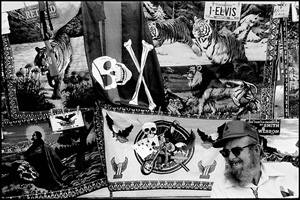
"US Culture", 1997
Meyer's work is indicative of an evolving photographic consciousness. He is using the computer as a powerful tool, exploring areas of photography that are just now beginning to be charted. As photographer Joan Fontcuberta states in the introduction to Truths & Fictions, Meyer's work is part of a "new documentary consciousness" where what was and what one remembers are one and the same. A picture is no longer just a "picture" and is not necessarily finished with the clicking of a shutter. "'Finished'...is always determined by technology. In other words, as soon as one is able to take something further we are tempted to do so. That is what art has done throughout the ages. But having the temptation does not imply that something that was done earlier will have to be redone all together. What happens is that one goes on to new elements, " says Meyer. "You also have to consider that the changes of technology have modified our notions of what a photograph is. For instance, the negative used to be a 'closed environment', which means that what was there was considered to be final. Today, that same negative might just be the beginning of something else. It's like taking bandages off ones' eyes...you can then see new things, which eluded one previously. The negative was the end of the road, today that same road has been opened and can be the starting point of some very fine adventures."
All reproductions ©1998 Pedro Meyer
Truths & Fictions by Pedro Meyer
with introductory essay by Joan Fontcuberta
Aperture Foundation, 1997 US$40
20 E. 23rd St., New York, NY 10010
(212)598-4205 or toll-free (800)929-2323
I Photograph to Remember by Pedro Meyer
The Voyager Co.
CD-ROM price US$49.95
578 Broadway, Suite 406, New York, NY 10012
(212)431-5799 or toll free (800)446-2001