May 11, 2008

social media in a nutshell

from Clay Shirky's Web 2.0 presentation of April 23, 2008

Here's something four-year-olds know: A screen that ships without a mouse ships broken. Here's something four-year-olds know: Media that's targeted at you but doesn't include you may not be worth sitting still for.

February 2, 2008

cabin building animals

ava and i made a video tonight while juliana was at a sleepover.

enjoy!

January 27, 2008

OMG! The alternative weekly, like, totally knows me!

this was my horoscope from the first Shepherd Express of the year (and the first horoscope i have looked at in a year or more):

Aries (March 21-April 19): I urge you to spend 2008 turning all of your pretty-good-but-half-developed notions into a few brilliant, fully formed ideas. While you're at it, melt down your hundreds of wishy-washy wishes and recast them into three driving desires. This is the Year of Pinpoint Aim, Aries, also known as the Year of Lasering Your Focus and the Year of Seeing with Fierce Clarity. Psych yourself up for a major campaign to cut the crap so the essence can shine.

You heard it hear first. Watch out for my Fierce Clarity, suckas!

January 21, 2008

Stop Motion Weekend

The girls and i have been having a lot of fun with iStopMotion this weekend. I picked it up as part of the MacHeist bundle.

First we discovered a sleepy snake wandering through the attic.

Next, Juliana tried to make friends with the snake, but it had other ideas:

Then this afternoon, Ava and I worked on a short tale of some hungry little pets.

The best thing about the snake attack video is that Ava worked as the director of photography while juliana directed and acted in the piece. They put this together by themselves while i was downstairs having some coffee!

Next up i think we are going to try either some whiteboard drawing or some pencil sketch and eraser animations. Juliana may even like to time lapse some of her watercolor paintings.

January 13, 2008

MacHeist - cheap software to raise money for charities

MacHeist is a sale that is running right now (the deal ends on january 23rd) that packages up a bunch of great independent mac software for a bundle price of $49. Now, this is a deal in and of itself (some of the software goes for more than 50 dollars by itself), but you can elect to send 25% of your purchase prices to one or all of a set of charities listed on the site. As of right now, they have raised $75,000 for charity and if they hit $100,000, they will also add PixelMator, the really lovely looking, layer-based image editing application, to the mix.

I purchased my bundle today after a friend from work pointed me to it and i am pretty excited. Snapz Pro and iStopMotion are the standouts to me and i can't wait to start making some animated shorts with my girls. :)

So if you are reading this and have a mac, what are you waiting for??? If you want to give this deal a shot, you can use my referral link.

December 14, 2007

mt open source

YAY!

Movable type is now officially, truly open source!

I have been using movable type for (/me goes to check my earliest entries) the beginning of 2003. In that time i have watched the application grow from a simple, beautifully constructed perl application to a beautifully constructed perl based publishing platform. I have a (sorely under-maintained) plugin - MTRecentImages and have set up blogs for family and friends.

Now that the release has been open sourced i am getting ready to roll it out to our many-hundred engineer team at work with some customizations to integrate into our environment better.

Congrats to the MT team for a continually improving product and platform and for keeping the platform open for all of us.

October 21, 2007

trying out the new umbrella with my flash

i started getting back into the craft of photography recently. This is my first good shot with a little umbrella i picked up on friday. Nothing spectacular, but enough to get started wtih.

August 3, 2007

DDJ Architecture & Design World: Randy Miller's "Agile Architecture"

Randy (Granville) Miller is an architect for Microsoft. He has a Microsoft blog. Last week i attended his session, "Agile Architecture" at the Dr. Dobb's Architecture and Design World Conference.

His talk started with a quick overview of agile and its benefits. As a side note, i was amazed at how much of that talk was happening at the conference. I assumed (there i go again) that it was so prevalent now that it was roughly a given. Apparently i assumed incorrectly.

After that was out of the way he talked for a bit about the place of architecture in agile methods and the disconnect between engineering practices and an entire business process or system. He used a quote from Kent Beck that is really spot-on:

My bias in writing XP originally was towards the programmers. That’s my background. That’s who I identified with on teams. However, the past five years have taught me that software development can’t be “the programmers and a bunch of other people�if the goal is excellence. Without balance between the concerns of everyone involved, some people will be unable to contribute to development, and their views are important to the team’s success.

My team's nearly 2 year experience with Scrum has certainly proven this out. In fact, Scrum's biggest benefits have materialized in communications and project management benefits over strict engineering benefits. While combining multiple roles on a single team is a fundamental agile tenet, the role of Architect is not often discussed and less so in an Agile Context. XP, Enterprise Scrum and Microsoft's MSF stuff were mentioned as methodologies that discuss the architect and architecture. The notion that architecture was unnecessary in an agile project was brought up as a fundamental myth about agile practices. After nods all around, he made his first suggestion: build stories to verify the architecture in a deployed sense, not on paper. For a client server application, build the client and the server with a really simple interface or a stub, but make it real. Put it in your environment and let it run. The appeal of making a design tangible is pretty interesting, even if it gets difficult for a lot of cases.

The rest of his presentation focused on the concepts of shadows. Working or existing code can cast what he called "Trailing Shadows". Reverse engineering databases into ER diagrams, java code into UML diagrams, etc. In my team, this has been incredibly valuable. It is a common sense task to take stock of what you have and document it, but i really like the term Trailing Shadows as an indicator of architecture. The mixture of a legacy code base and an expanding engineering team makes that particularly necessary for my team.

On the flip side of that, he talked about "Leading Shadows" from a design. Our leading shadows could come from whiteboard sketches, notebook pages, quick visio diagrams, etc. He stressed that these shadows should turn into working code within an iteration and not devolve into Big Design Up Front. Following on this discussion, he stressed building scaffolding for these sketches, writing tests for them and getting them into your continuous integration environment. A chart from his presentation shows the ideal progression of leading and trailing shadows over the course of a project.

Shadow Architecture Graph

As part of a retrospective after an iteration, review the shadows, suggested Miller. If you have leading shadows still, you need more development. If you have trailing shadows, then you are done with this architectural change.

The final interesting part of the talk was a focus on the inverse relationship between project size and the length of iterations/integrations. He gave an anecdote about the size of the team for the last Visual Studio release (~4-500 developers) and the 2 month iteration size. They found that they spent a ton of time doing integration testing and conflict resolution. This seems like a no-brainer, but is often hard to put into practice.

The shadow architecture concept is part of the Microsoft System Foundation for Agile Software Development. On that basis, i am going to do a little reading on that system. I don't develop for windows or use Visual Studio, so we'll see what is applicable.

Miller's talk was one of my favorites at the conference and helped me get some perspective on the "What is my sprint to sprint role as an architect?" question. His speaking style was great, the presentation flowed well between his material and the audience questions.

Juliana on Same Title Different Story

Chris has been running a site called Same Title Different Story for a while now. The mix of styles and stories has been pretty cool to listen to. For his third story, "Electric Current", he asked Juliana to contribute a story. After a little talk about what the title meant and what her story could be, Juliana wrote a second Super Cat adventure. I helped her clean up her sentences a little bit (basic stuff, not content) and we recorded the story on my macbook.

Check out her story and let me know what you think! Same Title Different Story

July 29, 2007

Dr. Dobb's Architecture and Design World

I spent most of last week at Dr. Dobb's Architecture and Design World in Chicago. While the name caused some of my colleagues to snicker, the conference had a great schedule, so i signed up.

Before i talk about any specific talks, i have a few comments on the conference itself.

  • The food and drinks could have been much better. Coffee was scarce and competition for a cup fierce. The boxed lunches got old quickly and there was no breakfast served, despite 8:30 start times for 3 of the 4 days.
  • Many talks needed a quick test before attendees were allowed to ask a question. Too many questions in talks with the word "agile" in the title either complained that agile was too hard for their app/company because of INSERT REASON HERE.
  • Much of the talk was about finding a place for Architecture in a process that is often interpreted as meaning, "Look ahead only 1 or 2 iterations. As long as we do test driven development, a quality product and architecture will emerge." Various speakers and attendees addressed this differently, but the conversation was very interesting.

I left the conference with several pages of notes to work through from many great talks. Here are just a couple of notes.

  • My favorite practical talk was Neal Ford's "Building DSLs in Static and Dynamic Languages" (download Neal's slides (pdf). Neal walked through some background on DSLs and then took 3 approaches to building one: building fluent interfaces (think method chaining) in Java, a Groovy example that cleaned up the java syntax and finally a Ruby DSL. He stressed knowing the syntax you want to be able to write and building towards that. Neal was a fantastic speaker and the session was a lot of fun.
  • Scott Ambler's keynote "Evolving Agile: Time to Address the Uncomfortable Issues We’d Prefer to Avoid" focused on the results of a recent Dr. Dobb's survey on agile methodologies. An interesting takeaway from his talk was the prevalence of modeling practices (from whiteboard to formal tool) in teams reporting successful agile projects. Scott focused on simple techniques and a sort of just in time modeling done at the beginning of an iteration for a limited scope.
  • Randy Miller from Microsoft gave a great talk entitled "Agile Architecture" and focused on guiding teams towards an architecture without resorting to big design up front. Modeling was a key technique he used, but as with Ambler's talk, common sense was the main rule. Model what you need to model to show what you have and where you are going based on what you know now. He also told an interesting anecdote about the last Visual Studio release. They had 4-500 developers working on 2 month iterations that resulted in a ton of time spent dealing with integration. The newest release that is in progress has apparently moved to shorter iterations.

I will be presenting some of my notes and thoughts to some of my coworkers in the next couple of weeks, so i will post some more info about specific topics and presentations over the next few days.

September 23, 2006

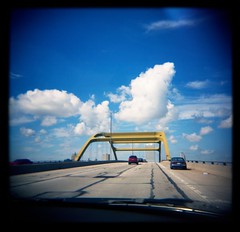
Crossing the Hoan Bridge

Approaching the Hoan

Since we live in Bayview, we end up using the Hoan Bridge quite a bit. It is a cool bridge that has a lot more history than i realized. I had always recalled hearing the Hoan called "The Bridge to Nowhere" (immediately causing the Talking Heads song "Road To Nowhere" to nestle into my brain), but i didn't really know the full story. While searching around for the proper spelling of the Hoan (Hohne? Hohn? Hone?) i came across a more elaborate history of the Hoan Bridge at the Wisconsin Highways web site. Pretty neat stuff. I had always thought that the bridge was only completed in the 21st century, but I was wrong. A section collapsed and was brought down for repairs in late 2000. Crazy!

Lake Michigan from 794 on the Hoan Bridge

I snapped these two shots off the bridge on a recent trip to the park with the girls. Ya gotta love the Holga + really old neg film + brilliant blue + good scanner combination.

September 21, 2006

Cleaning up a bit

ok. time to turn my blog back into something useful. Links are now going to be excluded from the front page as full blown entries. I think i will take advantage of the JSON interfaces that Delicious offers and try my hand at some of that javascript the kids won't shut up about.

Ok, that's it for the "Post where blogger writes about all the crap they won't actually get around to." Those of you who know me get enough of that from listening to me in person.

August 20, 2006

there is just so much wrong with this video

ZDNet and Microsoft have these ads playing right now where a "Developer Evangelist" is standing at a whiteboard espousing how awesome visual studio is.

I actually watched one of these, and it was focused on the visual studio team system. The video is like watching a minor nightmare. The thrust of the entire presentation is that for each of the "roles" on a project, there is a tool to cut off the need for persons of that role to speak to or work directly with persons of a different role. The roles are familiar: developer, architect, tester, build manager and project manager. It is nice that MS is looking at ways to facilitate collaboration, but sharing responsibility and building up a cross functional team is a much better solution in the long run for everyone involved.

Granted, i am judging a tool and an entire corporate philosophy based on one goofy advertainment spot, but i think it is a good picture of the super tool heavy view of development that has infected so much of the software industry. Busines and development knowledge trumps tools knowledge any day.

August 12, 2006

I have a backlog problem

I love to read. I read technical books, comic books, fiction, economic theories, etc. At the moment, i have a fair amount of stuff piled up to finish reading, though. I have one small, 3-high shelf unit in my office. This was chosen deliberately to limit the amount of stuff that i have out and in my queue. 2 weeks ago, though, i also had 3 knee high stacks of books lying around as well. I cleaned those out on a sunday afternoon and was left again with my 3 high shelf and no more. Those three shelves are a bit daunting though. Here are the books in my queue right now:

Bottom Shelf:

  • Code Complete veresion 2, Steve McConnel
  • Higher-Order Perl, Mark Jason Dominus
  • V For Vendetta, Alan Moore and David Lloyd
  • Ghost World, Daniel Clowes
  • Winsor McKay, Early Works vols I && II
  • Scary Godmother: Ghoul's Out For Summer, Jill Thompson
  • Stray Toasters, Bill Sienkiewicz
  • Hutch Owen: Unmarketable!!, Tom Hart
  • Abe: Wrong for all the right reasons, Glenn Dakin
  • Big Questions #s1-8, Anders Nilsen
  • The Photoshop CS2 Book for Digital Photographers, Scott Kelby
  • Metropol #s 1 & 3, Ted McKeever
  • Batman: The Dark Knight Returns, Frank Miller
  • Sandman: A Game of You, Neil Gaiman
  • A Walking Tour of the Shambles, Gene Wolfe & Neil Gaiman
  • Various issues of Software Development, Dr. Dobb's and Wired
  • Voice of the Fire, Alan Moore
  • How To Win in the Chess Endings, I.A.Horowitz
  • UBIK, Philip K. Dick
  • How To Solve Chess Problems, Kenneth S. Howard
  • The Psychology of Children's Art, Rhoda Kellog with Scott O'Dell

Middle Shelf:

  • No Books! Only printer media for the new epson, plus dvd-rs and cd-rs.

Top Shelf

  • Tintin in the Land of the Soviets, Herge
  • Krazy & Ignatz: 1929-1930, George Herriman
  • Canon GL2 Instruction Manual, Canon
  • Open Source for the Enterprise, Dan Woods & Gautam Guiliani
  • The Pragmatic Programmer, Andy Hunt & Dave Thomas
  • Getting Things DONE, David Allen
  • Java 2 Complete Java 2 Certification, Phillip Helller & Simon Roberts
  • Patterns of Enterprise Application Architecture, Martin Fowler
  • Agile Project Management with Scrum, Ken Schwaber
  • Refactoring, Martin Fowler
  • Working Effectively with Legacy Code, Michael Feathers
  • Concepts, Techniques, and Models of Computer Programming, Peter Van Roy & Seif Haridi
  • Walt and Skeezix: The complete Daily Comic Strips, Frank King
  • The Complete Peanuts: 1950-1952, Charles M. Schulz
  • How We Are Hungry, Dave Eggers
  • Squeak: Learn Programming with Robots, Stephen Ducasse
  • Practical Development Environments, Matthew B. Doar
  • The Timeless Way of Building, Christopher Alexander
  • The Man in the Ceiling, Jules Feiffer
  • Jaka's Story, Dave Sim & Gerhard
  • Melmoth, Dave Sim & Gerhard
  • Make Magazine, issues 1-5

whew. i am tired. now i need to go curl up with a good book. :)

August 2, 2006

New Flickr Set for Drastic Color Corrections and retouchings


Tracey with Sleepy Ava
Originally uploaded by plural.

I have started a new photo set on flickr to hold my color corrections and retouchings. I find that as i make corrections, i don't keep the originals around (unless i shot them in RAW with the 20D), so i lose the knowledge of how i corrected the images.

Take a peek and let me know what you think!

Archives